PARTNER CONNECTION
SUMMARY
-
Partner connection is the heart of tango. It is
probably the biggest source of enjoyment in this dance. Good partner connection
opens the way to an unlimited evolution of this dance, while inefficient
partner connection creates some of the biggest corruptions of it.
-
Leading and
following are the basis of the language of tango. Good leading and good
following keep this dance honest and spontaneous. Transcending leading and
following is possible at higher levels of mastery.
-
Closeness
of the connection and individual freedom
of movement may at first appear in conflict with each other, but ultimately
turn out to serve each other. Closeness of the embrace may be sacrificed for
training purposes, but is ultimately a necessary attribute of evolved tango
dancing. THE MAIN CHALLENGE in partner connection is to unite as fully as
possible with the partner while at the same time keeping the freedom and the
integrity of individual body movement.
-
Good partner connection progresses in the direction of
the effortlessness.
-
Good partner connection is balanced. Any leaning on or pushing against each other is a
gross (though unfortunately all too frequent) corruption of the dance.
-
Good connection has a quality of stillness.
-
The ultimate partner connection is as centered and as symmetrical as possible,
though without extraordinarily good body conditions this is difficult to
achieve. Before a perfectly centered connection is possible, it is important to
create a connection that allows for gradual centering.
-
Good partner connection is synchronized, which means that the partners’ rhythms and
transfers of weight are attuned to each other.
-
At the end of this section, I summarize major practical considerations.
PARTNER CONNECTION
Good partner connection is the heart of tango. In my
experience, the inexhaustible magic of this dance is found in the joining of
two people into one psycho-physical being. This is why the mark of a good
dancer is above all how good it feels
to dance with him or
her. I know people in Buenos Aires whose repertoire consists of only three
different patterns, but who are able to create very enjoyable experiences for their
partners through the quality of their movement and connection. But a good
partner connection does not have to mean a limited choreography. Ultimately, it
is through a good partner
connection that the advanced musical and choreographic possibilities of tango
are achieved.
I will first discuss Leading and Following, the distinct male and female parts in
this dance. I will then describe what I believe are important aspects of good
partner connection:
-
Freedom
-
Balance
These are aspects of the optimal partner
connection, which is very difficult to accomplish. But all of them represent
directions of improvement, meaning that even a little more effortlessness,
balance, etc., creates a better connection. At the end of the section, I will
mention some Practical Considerations
and the different approaches that one can take before the optimal partner
connection is developed.
I say repeatedly that no breakdown, no part-by-part
analysis can ever describe dancing fully.
Same goes for partner connection. The following discussion of it may
help a serious tango student become aware of and overcome common pit falls and
limitations which often go unnoticed. Most of the aspects which I mention -
freedom, integrity, balance, effortlessness, centeredness, synchronicity - are
desirable in any interaction, and are therefore good to think about. But even
so, the most powerful tools for developing good partner connection are our senses.
It is first of all about using our physical senses to improve the connection in
the process of dancing, but it is also about our artistic, aesthetic senses, as
well as our common sense. Seeing a beautiful connection within a tango
couple can do more for one’s dancing than all the reading and thinking about
it. Partner connection in tango dancing touches the archetypal level of the
psyche. It is inevitably an expression of how we relate to others and
especially to the opposite sex. In making a good partner connection, we should
first and foremost trust our intuition and our senses to find beauty in it. To
think, talk and write about it as I am doing here can at best help this
process, but can never replace it.
A tango couple is made up of distinct male and female
counterparts. The distinction begins with leading and following, as in most
types of partner dancing. The differences do not stop there, but even the
distinction between leading and following is not as clear cut as may seem at
first. As in the “yin-yang” Tai Chi symbol, there is a part of the opposite in
both the male and the female. At this point, the very terms of
"leading" and "following" do not even seem very appropriate
to me. I would say that it is more like "call and response". The man
initiates, and the woman responds, but both are leading and following to a
certain extent. The leader is most effective if he knows how to follow his
partner, blend with her movement, and the woman is most exciting to dance with
if she does not just follow but also dances her own rhythm and musicality,
thereby inspiring the leader.
It may at first seem that in order to merge into one
psycho-physical being the "follower" must completely submit to the
"leader", but that is only a superficial view. To begin with, it is
much easier to move your body freely while following than while leading. It
usually takes much longer for a man to free up his movement while leading and
navigating the floor at the same time. This means that the man is in a way
dependent on how well the woman moves, as I will explain in more detail below.
Moreover, if the merging is accomplished through effortlessness and sensitivity
to each other, it actually opens up a higher degree of freedom for both
partners. The choreographic freedom is somewhat different for the man than
for the woman - the woman never takes charge of the sequence of weight transfers. But she has a greater
interpretive freedom, in the quality of the step, the embellishments, and, if
the man is advanced enough, the rhythm and the timing of each individual step.
The more sensitive and synchronized the connection, the more the man can listen
to the woman and let her own musicality manifest. It is the man who usually
determines the sequence of
steps, which is why it is important to give the woman the freedom of the rhythm of the step. If the man
controls both the sequence and the rhythm, he is dominating the woman too much.
In my experience, the most mutually blissful states are reached when the man
attunes to the rhythm of the woman to such an extent that she feels that she no
longer has to put any effort into "following" (see Synchronicity
below). She then begins to feel much freer to dance and respond to the music,
which includes both the varying intensity and color of her movement, as well as
the embellishments. Such a synchronized connection also makes it possible for
the man to forget about "leading", and for the most part just dance -
his very movement effects the lead. The sequences of steps are communicated
effortlessly and are adjusted naturally to the particular woman's rhythm. Plus,
the man can actually lead more
different steps through such integrity. This may sound improbable to many, and
I cannot yet demonstrate it clearly, but I have had enough experiences which
convinced me of this.
The "leading and following" is essential to
tango, however. It is upon the
fundamental difference between male and female roles that the whole dance is
built. For both partners, there is unlimited freedom to be discovered, but also
certain basic rules of the game to respect. I have seen some attempts to
equalize the roles of the man and the woman in this dance by letting them
interchange lead and follow in the course of a dance. In my experience, these
attempts do not lead to very good tango. It is possible that, at very advanced
levels of dancing, such an interchange can take place spontaneously, but if
done deliberately, on cue, it just breaks the flow of the dance and destroys its
non-competitive and spontaneous nature. In my experience, it is better to keep
the male and the female defined as the counterparts in this dance, and let the
partners look for each other, as well as for the balance of the male and the
female inside themselves, each from the point of view of their respective
roles. In fact, many people enjoy the clear definitions of masculine and feminine
roles in tango, for they feel there is not enough of it in modern life.
A great challenge in tango dancing is creating a close
and unbroken connection with the partner, at the same time as keeping the
freedom of individual body movement, as well as the freedom of choreography and
musicality of this dance. Superficially, it seems that a closer connection will
necessarily limit the freedom of choreography, and that in order to do more,
the partners need to separate. Most tango dancers find themselves somewhat torn
between wanting to be close and wanting to do more “steps”. If the closeness
seems more important, people tend towards the so-called “close-embrace” style,
and if the freedom of choreography is the priority, they favor the “open
embrace”. Some people alternate between the two modes during the same dance.
The main reason for this dichotomy is once again the
poor body conditions. In most male dancers the posture is somewhat slouched, so
that when they try to get close with the partner, the heads meet before the
chests, and it seems necessary to put the heads to the side of each other,
looking over each other’s shoulders. This alone ensures that the couple is never
truly centered. The heads usually end up touching, which makes the
whole connection fixed, taking away its ability to “breathe” - adjust and
balance itself. The partners tend to wrap their arms very far around each other
to ensure complete unity, which further adds to tensing up and contorting of
the upper bodies. In addition, many “close-embrace” dancers end up leaning on
each other, giving up individual balance, which is probably the
biggest corruption of this dance (see Balance
below). Because of these constrictions, the freedom of individual body movement
is greatly compromised, and the choreographic possibilities of a
“close-embrace” dance are extremely limited. Even such fundamental pattern as
the 8-point turn usually feels very uncomfortable in this kind of embrace.
All this is the cost of a close connection, which is
rightfully considered by many the heart of tango. “Open embrace” dancers, who
keep a distance from each other, give up this essential closeness, but
(initially) gain more choreographic freedom, as well as the freedom of body
movement. They do not have to contort their bodies and can easily dance
centered, right in front of each other. But they rarely achieve the subtlety,
the sensuality, and the precision found in a close embrace. Moreover,
open-embrace dancers forfeit much of the evolutionary potential of tango.
Achieving closeness and freedom at the same time requires an improvement of
one’s general psycho-physical being, which open-embrace dancing does not. To
dance close with each other requires a much higher degree of precision and
awareness of the partner’s body. And it is in close embrace that the power of
tango as a metaphor of a relationship manifests most fully. Can you be close
yet free? When you get close, do you begin “stepping on each other’s toes”?
When you get close, can you “keep your balance”, or do you start “leaning”,
“depending” on each other? Do you connect with the “head”, with the “belly”, or
with the “heart”? Such issues are, in fact, physical expressions of one’s
character, one’s general relationship patterns. Experiencing them in one’s
dancing is an opportunity to face them and work on them, which open-embrace
dancers never take advantage of. Dancing close is also a test of
effortlessness, which is an essential attribute of any fine art – an overall
level of tension and roughness is very apparent in a close embrace.
The ultimate partner connection is at once close and free. This understanding existed
during tango’s golden age in the 40’s and 50’s, when most people danced close
to the partner, but never locked the heads or the shoulders together. Moreover,
paradoxically, the most freedom in this dance is achieved through the deepest partner connection. If the partners are
able to stay close without losing their balance or locking the bodies together,
they are so much more attuned to each other, so much more able to respond to
each other spontaneously, and therefore to improvise with a greater freedom.
The challenge is to be as close as possible, almost touching or touching ever so
lightly, yet not getting stuck or locked against each other. In this
close but unfixed connection, all proper tango choreography can be executed -
the bodies may turn and shift with respect to each other, but there is no need
to ever separate by more than a couple of inches. At times, when I was able to
enter into such a connection with the partner, my body started discovering
choreographic possibilities which I had not even imagined, but which seemed to
come out naturally of that level of connectedness. At the same time, my partner
suddenly felt freer to dance with more creativity and expression. Such
experiences have shown me clearly that it is through improving the connection
and through keeping it close that the greatest freedom of choreography and
musicality is achieved. Each partner becomes able to dance at once as an individual
body and as an integral part of the couple. The dancing and the
communication become one.
There is value to dancing in open embrace sometimes. One
can immediately experience the centeredness, the verticality, and the overall
comfort which takes years to achieve in close embrace. One can also experiment,
at least conceptually, with more choreographic possibilities. However, until
one can execute a figure in close embrace, one has not really mastered it.
Open-embrace dancing is good for some experimentation and exploration, for
beginners who initially find it very uncomfortable to dance close, and also for
training
balanced dancing when one or both partners have become used to leaning or
pushing (see Balance below).
True tango is danced close all the time, in an embrace
that is flexible but unbroken. “Tango es para bailar tomado” – “tango is for
dancing in an embrace”, said the old-timers. Having experimented repeatedly
with both open and close embrace, I have come to the same conclusion. Only in a
close embrace does one find the true depth and evolutionary significance of
this dance. But one must be careful not to fall into extremes: “close” does not
mean “stuck” or “off-balance”. In a close embrace, both partners should be
perfectly balanced and no points on the bodies should be held in sustained
contact except for the hands. The main point is closeness and a feeling of
embracing and being embraced. Such feeling is possible even if partners
are separated by an inch or two, though the smaller the distance, the better.
An embrace that is unacceptably open is easily identifiable by the man’s right
hand that ends up on the side of the woman’s body, instead of somewhere on her
back.
The main road to achieving the close but free
connection is the work on the body which I will discuss in the Body Conditioning section. For
example, it is possible to gradually improve posture so that the heads no
longer have to touch, even when the partners’ torsos are right up against each
other. Through the improvement of standing and walking, it is possible to
gradually feel more and more freedom of body movement in a close embrace. Until
such optimal body conditions are achieved, my recommendation is to resist the
temptation to do the “steps” which seem to interfere with a good connection.
Good connection should take priority over varied choreography. In fact, any
“step” which seems to interfere with a good connection is simply not done
properly. Connection should be gradually developed, until all “steps” naturally
come out of it. This is a tall order, especially for many male dancers. When I
was first learning tango, all I wanted was more “steps”. Eventually I
understood and experienced a deeper enjoyment of this dance, which had very
little to do with how many different patterns I could perform, and was more
about the quality of connection and musicality. I noticed that while trying to
execute some of the harder figures I was losing a good connection, falling out
of sync with the music. I eventually decided to forget about 95% of all “steps”
which I had “learned” in classes, and only do that which did not interfere with
a good connection. I also kept working on my body conditions, and as they
improved, many choreographic patterns which had previously felt difficult
started coming out spontaneously and without any breaks in connection. For
example, I can now do all six front sacadas without separating, which felt
impossible about 5 years ago. In my experience, such an approach is better than
attaching to difficult choreographic patterns and practicing them over and over
again, waiting for them to stop interfering with a good connection. It is much
more effective to focus on a good connection, and let the choreography follow.
The challenge of achieving at once the integrity of
the couple and the freedom of individual expression would in itself make tango
a worthwhile pursuit. In that, it is a metaphor of any relationship,
particularly the relationship between the sexes. One has a chance to discover physically
the interdependence of freedom and connectedness.
Effortlessness of partner connection is like a doorway
which opens the way for freedom, integrity, and synchronicity of it. Without
it, one cannot even be sufficiently aware of the partner’s or of one’s own body
and movement. If one is going to work on one thing only, let it be the
effortlessness - many other good things will automatically come along with it.
The more tension I have been able to "drain"
out of the embrace, the more magical the dance has become. As connection
becomes more effortless, partners become able to better sense each other’s
movement and respond to each other more directly. They are less and less aware
of the means of communication, and the dance feels more and more like
a spontaneous dialogue.
A good way to make the connection more effortless is
to bring one's attention to
all points of contact with the partner, and intend the pressure to be as light as possible, as
non-existent as possible. Another useful intention is to at once yield and stick to every movement of the partner (this goes for both men
and women). This principle is fundamental to effortless sparring in Tai Chi. It
is also useful to keep in mind that everything can be communicated with the
lower body, ultimately just with the pressure of the feet on the floor. It may
take years to get to that point, but one can always try to "drain"
the effort down, closer to the ground. The upper body should be an effortless
and increasingly sensitive “listener” to one’s partner. Any necessary effort
can and should be confined to the lower body - the center and the legs. It is
then that the line between leading/following and simply dancing becomes erased.
It is very helpful to pay attention and eliminate any manipulation in the upper
body, which often goes unnoticed. I try to make sure I am not leading at all
with the arms or the chest, intending all communication to come from the center
of the body, and all the power - just from the pressure of the feet on the
floor. This is why the quality of partner connection depends greatly on the
degree of one’s grounding.
Ultimately, even the effort in the legs and the feet
should be reduced to a minimum. The effortlessness of the connections in the
end depends on the relaxation of the whole body. Relaxation is a difficult issue,
which I will discuss in more detail in the Body Conditioning section. It is one aspect of good body
movement which one can work on both off and on the dance floor. More relaxation
while dancing immediately and almost automatically leads to a more sensitive
and effortless partner connection. Just as one can “scan” all points of contact
for pressure, one can scan one’s own body for tension, intending to let go of
it. The Alexander Principle which I discuss in the Body Conditioning section can be
used right in the process of dancing, and can lead to instant improvements of
all aspects of the dance, particularly connection with the partner.
Besides grounding and relaxation of the body, its verticality is also very
important for the effortlessness of partner connection. Especially some of the
more challenging choreographic possibilities of tango become easy only when
both partners relate to each other with their axes. If one’s body is as though
suspended vertically, a little “swing” of it this way or that is often enough
to effect the lead. This is why many old-timers used to say that in order to
dance tango well one needs to be able to stand up straight. Verticality in a
close embrace requires extraordinary body conditions. I still often find myself
sacrificing verticality for the sake of closeness, bending forward somewhat,
though much less than before.
The intention to “let go”, to “release” tension and
effort is good, but can sometimes be understood by the body as some sort of
collapse or an acceptance of powerlessness. I have found the intention to neutralize
very helpful. It can be applied both to one’s own weight, as well as to any
effort one can encounter in the connection or the body of the partner. The
intention to neutralize provokes an instinctual aligning of the body in just
the right way so as to effortlessly compensate any momentary imbalance. By
contrast, if one intends to counteract the imbalance, one will
only exaggerate it. Neutralization should be projected from the center of the
body and applied to the whole couple at once. It is an example of pure intent,
which may initially seem too mystical, but ends up being more effective than
“mechanisms” and “techniques”.
There is a common misconception among tango dancers
today that dancing close means leaning or pressing on each other. This is one
of the biggest corruptions of this dance that I am aware of. This was unheard
of in the tango's golden age. Some performance artists used the off-balance
position for an exaggerated or comical effect, but it was not real dancing. A
human body cannot move right if it is robbed of its balance. A great challenge in dancing tango is to
feel completely joined with the partner while retaining one's own balance and
integrity of movement. Off-balance dancing is a shortcut to a close
connection, but at the same time it is a dead end. There is always a level of
excess muscular tension in both bodies necessary to maintain the off-balance
position, which means that the principle of effortlessness has a short limit
there. Besides, most of tango's choreographic possibilities never work well if
the body is not balanced.
Balance must be complete – even if only the weight of
the woman's arm is placed onto the man's shoulder, the whole couple is robbed
of its equilibrium. For most beginners, it takes some time to develop the
necessary endurance in the arms to be able to keep them up for the duration of
a tanda or even one song. Women dancers who are not paying attention to it,
often get used to "hanging" on the man or using his body as an arm
rest. Less noticeably, off-balance dancing also happens when the woman provides
"resistance" to the movement of the man, and lets him physically push
her around the floor. Even some of the most experienced dancers fall into this
vice. It seems that they are often not aware that they are letting themselves
be pushed, so used they have become to it. In pure tango dancing, the woman
moves independently, follows actively, choosing to move with the
man while at the same time staying connected, rather than letting herself be
moved around. To learn this for many dancers would mean a fundamental
retraining of oneself, almost like becoming a beginner again, which,
unfortunately, few experienced dancers are willing to do.
The main reason that such off-balance corruptions are
so common is that they provide shortcuts to a closer connection. It is
initially much more difficult to at once maintain a close embrace and keep the
bodies perfectly balanced. But with some patience and work on one's posture and
movement, it is entirely possible. The trouble is that many dancers get caught
in the off-balance position, for it lets them achieve a more unbroken
connection, a more varied musicality, and stillness faster, and then it is
difficult for them to give it up and wait for the same things to happen by less
corrupt means. In particular, the lean makes it a lot easier for the man to
slow down the weight transfer of the woman – a very important feature
of more advanced dancing, which is much more difficult, yet entirely possible
to achieve without sacrificing the balance ( see Synchronicity below). Another
reason that people dance off-balance is psychological - it can be stressful to
be so close together yet not cling to each other.
Let's say that one understands that it is better to
dance on one's own balance. But what can one do if one's partners do not agree?
The first answer is: dance only with people who let you dance in a balanced
way. But if such people are hard to find, one can also gradually move out of
the unbalanced habits, without the other person noticing. This takes
considerable time and skill, but has a good effect on the whole tango
community, for many of those partners will eventually feel the advantages of
balanced dancing. For the woman, the main thing to do is to "stick and
yield" without leaning, "hanging", or “resisting” – to be on her
own balance without breaking the connection. The ability to do that depends on
grounding and relaxation (see the Body
Conditioning section). For the man, it is actually possible to neutralize
all the weight that the partner is trying to put on him. It is best done with
pure intention
to neutralize, which I have mentioned above. One can also try to yield
to any pressure from the woman, but I have found this largely ineffective: a
woman who has become used to being moved or supported just ends up falling all
over the place. When neutralization does not seem to work (it is a very
advanced skill), I recommend separating just a little bit, enough to have no
contact in the head, the torso or the shoulders. This is the case where the
slightly “open” embrace is useful. This is also, I believe, what the woman
should do if the man tries to pull her into a lean, which I hear happens quite
a bit.
I cannot stress enough that, in my view, off-balance
dancing is the biggest modern corruption of the practice of tango.
During my latest trips to Buenos Aires, I could hardly believe the contrast
between the older ladies I danced with, none of whom ever “leaned” or allowed
themselves to be “pushed” along, and the younger women, most of whom insisted
on an off-balance connection. I ended up dancing with the older ladies most of
the time, for I felt that the off-balance situation was creating corrupt
patterns in my dancing.
I mention stillness repeatedly, for it has a
tremendous effect on all aspects of the dance. Stillness can be experienced not
only within individual movement, but also in the partner connection. It means
the ease of stopping, slowing down or speeding up – at any phase of movement.
Ideally, all movement proceeds within stillness. Someone who has
never experienced that can imagine an ability to turn everything into extreme
slow motion, without any effort. Ultimately, stillness also allows the couple
to execute very fast patterns without losing good connection. It lets the
partners respond to each other continuously,
not just at some convenient moments. For instance, a couple should be able to
pause at any phase of the step, not only at the beginning or the end of it. A
man who achieves this uninterrupted stillness opens up tremendous levels of
freedom for the woman, for no matter what she does or how long she takes to do
it, his body is able to respond and/or wait for her. That is when the dance can
truly become a dialogue. Stillness also opens up a larger freedom in mutual
improvisation. When each step proceeds in stillness, there is time to explore
and play creatively, and sometimes discover new choreographic possibilities
without breaking the flow of the dance. A “mistake” only happens when the
connection is lost or when someone is off-balance. In stillness, both the
connection and the balance can become so secure, that one becomes able to
experiment virtually with no risk. It is interesting that one partner can bring
the other into stillness. It is probably easier for the man, but women can
definitely do that as well - I have experienced it both ways.
True stillness is dependent on neutralizing the effort and
centering,
but even more so on good walking. It is through good
walking that the woman can make the connection more effortless and weightless,
“sticking” to the man’s movement, but yielding to it at the same time. (I will
explain this in more detail in the Body
Conditioning section.) For the man, in addition to “sticking and yielding”
to the partner’s movement in the same way, it is also possible to help neutralize
the effort in the woman’s body (through intention), as well as to find her
center and center axis (through attention).
The experience of stillness is talked about in many
fields, such as sports, martial arts, other types of dance, horseback riding.
It is found mostly by intending it and noticing the moments when more stillness
suddenly happens. In tango dancing in particular, I found it useful to intend
stillness from the top down, trying to keep the hands, the shoulders, and the
head as quiet as possible (though not stiff). I try to imagine that the
hands are just to hold each other in stillness, but not to lead – the center of
the body is what leads and responds to the lead. The hands (especially the left
hand of the man and the right hand of the woman) are still “nodes” which
transmit the communication, but do not initiate it.
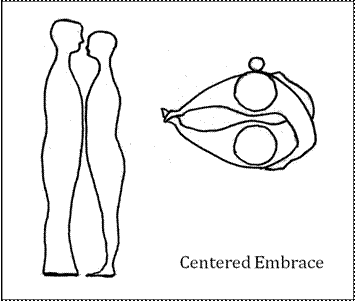
The ideal position of the couple is the centered
position. By this I mean that the partners are right in front of each other,
facing each other, with their shoulders and hips parallel to the partner's.
This position is very hard to achieve, which is why tango has been danced
mostly in some off-set way, with the woman's body towards the right side of the
man's. However, some advanced dancers from the 40's and 50's were able to
achieve the more centered position and spoke in favor of it. Tango is best
danced "bien enfrentados", they said. The ability to dance that way
in a close embrace depends, once again, on developing proper natural movement
and posture. The head, the ribcage and the pelvis must be well aligned
vertically, so that the bodies can touch front-to-front without the heads
touching. The hips and the legs must have their proper freedom of movement if
there is to be no interference in in-line walking. I am still far from achieving this fully, but
I am already able to dance centered with some people some of the time, enough
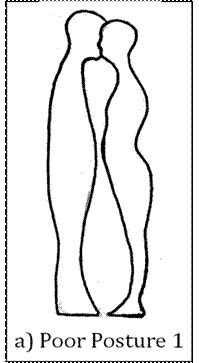
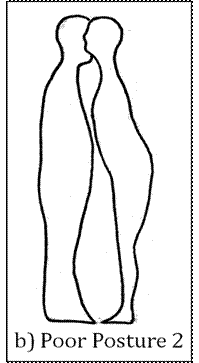
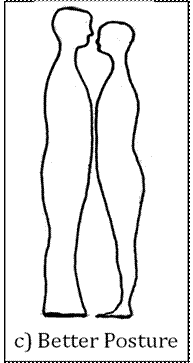
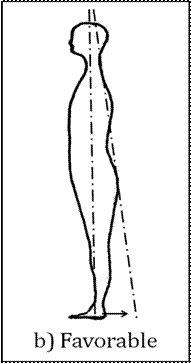
to know that it is possible. Figures 1(a) and 1(b) show examples of how poor
posture interferes with the ultimate partner connection. In both of these
cases, the partners are forced to place the heads on the side of each other,
and most likely get “stuck” with the heads as well. Perfect centeredness is
impossible there. Figure 1(c) shows a better posture of both partners, where
they can be close yet centered, and also keep much more freedom of individual
movement.
FIGURE 1
The ultimate elegance of tango is in the perfect
centeredness of the couple. The closer we get to such symmetry, the more
naturally everything else falls into place, especially effortlessness,
synchronicity, and integrity. If the position is not perfectly centered, some
subtle manipulations are always necessary, some sacrifices are made somewhere,
which do not allow for full relaxation, and do not let the dance be as free as
it is in the centered position.
A good connection is centered in more ways than one.
The movement of the couple is balanced when it proceeds around a common center,
as well as around a common center axis. Some people believe that there are two
distinct modes of dancing tango: either with a shared axis or with separate
axes. In my experience, however, this dichotomy is not necessary. In a close
and centered connection, there is no conflict between the axis of each partner
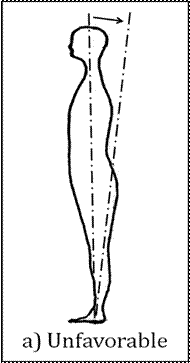
and the axis of the couple. It is very difficult and probably unnecessary to visualize
how the individual axes relate to the common axis, but it is very possible to feel
it happen. I have found it useful to look for the partner’s axis (through
attention) and to try to let it be still (through intention). At best, I feel
that I am letting her axis be balanced as though it was suspended from above.
To let her axis move anywhere is to intend it to “swing” in a balanced way, as
opposed to “tipping” it off balance.
FIGURE 2
One can argue that perfect centeredness is impossible
in a tango embrace, because the left and right arms are not held symmetrically.
That is probably true, but what I am talking about is the sense of centeredness, meaning that even though some
compensations for the asymmetry of the arms do occur, the bodies feel like they
are allowed to find each other center to center, like the needle of a compass
that finds North. When such freedom exists, it feels like the two bodies are
balanced around a common center, and a slight deviation of one body from it is
immediately sensed and responded to by the other.
A perfectly centered connection which is close at the same time
is incredibly hard to achieve – it takes extraordinary body conditions. For
most of us with less-than-perfect body conditions, it is important to find a
way for a gradual centering. The usual close-embrace position, for
example, makes centering impossible, for the heads are always on the side of
each other, as in Figure 3(a). In general, if the heads are touching in any way
rather than “head-on” (which would be silly) the possibility of centeredness is
effectively blocked. One possibility is to separate enough that the heads do
not have to touch and try to gradually get as close as possible without getting
“stuck”. But dancing separate robs tango of some essential features, as I have
explained above. This is why I recommend what I will call the “angled” position
(Figure 3(c)):
FIGURE 3
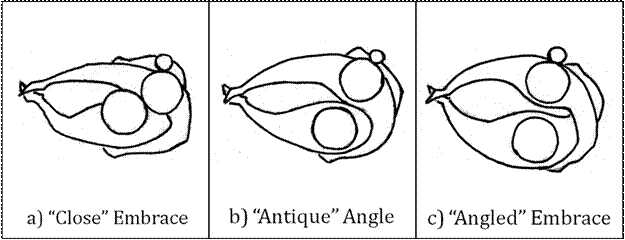
The "angled" position was actually the most
common one among dancers in the 30's, 40's and 50's, as can be seen from a few
surviving videos and photographs. One would rarely see the heads touching, and
looking over the man's right shoulder (as is routinely done in the
"close-embrace style") was considered inefficient and the province of
inexperienced dancers, as I have heard directly from some old-timers. The only
variation was that sometimes the woman was directly up against the right side
of the man's chest (Figure 3(b)), which may feel more comfortable to some, but
in my opinion is not as good as the one in Figure 3(c).
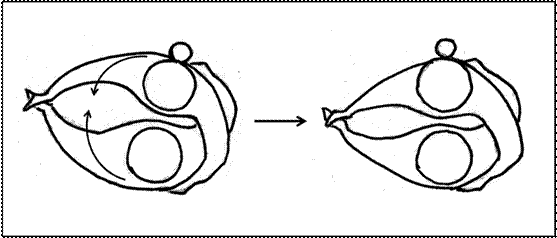
I believe that the angled position, which is more open
on the left side of the man, is what has created the "cross" on the
left in the first place. The angle can be adjusted according to both dancers’
comfort and posture, and can be gradually decreased, creating an increasingly
centered and parallel connection.
FIGURE 4
Centeredness may be the most difficult aspect good
partner connection – we must be patient with ourselves and each other and be open
to approaching it from different starting points, as I will explain in Practical Considerations.
The most sublime connection between tango partners is
accomplished when their weight transfers become connected. I
call it synchronization, but the term is not exact. I can’t quite find a good
word for it – it is more like “attunement”, for I do not mean that partners
should always transfer the weight at the same time. There are some steps, for
example, when one of the partners is transferring the weight, but the other is
not. But even in those steps, it is possible to get “inside” the partner’s
weight transfer. I found it especially true from the man’s point of view, but I
believe it applies in almost the same way to the woman’s part. It is
about sensing and accompanying the partner’s transfer of weight while staying
as still and balanced as possible. For most people nowadays, walking
involves some degree of gentle falling off of one foot and on to
the other. Some people manage to synchronize such falling with the partner
enough for the dancing to feel fairly connected, but if one learns how to
connect in stillness, one enters a whole other dimension. If one is able to
connect to the partner’s step while staying perfectly balanced, one can let the
partner’s movement be entirely what it is, without breaking the integrity of
the couple. If one of the partners is able to do it, the dancing is pleasant.
If both partners are doing it, a great dimension of musical freedom and mutual
improvisation opens up. Synchronization is one of the most important skills for
a tango dancer. In my experience, it
is the main gateway to freedom in this dance. The more one gets
"inside" the partner's weight transfer, "inside" each step,
accompanying it in stillness, the more effortless and free the connection. The
old-timers referred to this skill when they said that “many can follow, but not
many can accompany”. By “accompanying” they meant being
with the partner through each step, each transfer of weight.
The "transfer of weight" is another standard
expression which does not seem accurate to me, for good dancing feels pretty
weightless. It is the
transfer of weight, but when it is good, it feels less like weight and more like energy. In Tai Chi they
use somewhat more appropriate terms of "emptying" one foot and
"filling" the other. The concept of “weight” provokes heaviness,
which is no good for dancing. All sensation of weight anywhere except for the
soles of the feet should be neutralized, erased.
Before sufficiently good body conditions are attained,
synchronization can be helped by a variety of techniques, such as “fist the
foot than the body” (see the Body Conditioning
section). This is especially useful for the woman’s part. It means placing the
stepping foot on the floor lightly, while keeping most of the weight on the
other foot. This effectively eliminates “falling” into the step (transferring
the weight almost at the same time as placing the foot on the floor), and lets
one adjust to the partner’s transfer of weight more easily, by waiting and
transferring only when the partner does, as quickly or as slowly as the other.
This technique is especially useful for the woman, and can make a world of a
difference for her ability to connect. It is probably the single most important
thing to learn for a woman in order to initially become comfortable to dance
with. Ultimately, however, it is not about any technique, but once again about
improving one’s fundamental movement. Good natural movement is easy to control,
easy to slow down or speed up at will. In good walking, there is a natural
separation of step and weight transfer, which minimizes the stress on the joints,
and also lets one stop and change directions easily at any phase of the step
(more on this in the Body
Conditioning section). If one’s natural movement is not well-developed, one
usually ends up using some techniques to accomplish, for example, the gradual
weight transfer. This is why many women learn how to stretch the leg back
artificially – it initially makes the dancing work better, but never feels as
sublime (to both partners) as the good natural movement, free of any
mechanistic techniques.
For the man, the challenge is similar – to accompany
the partner in stillness, but his approach should be somewhat different, in my
opinion. If for the woman the main focus should be slowing down her own
transfer (without resisting), for the man it is more about slowing down the
partner’s transfer (also without resistance). The woman does not
initiate the weight transfer – the man does. This means that he can learn to
initiate it in such a way so as to prevent the woman from ever “falling” from
one foot on to the other. Good movement does use gravity and always involves
some “falling” or rather letting down. However, it is not
falling from one foot to the other, but more like sinking, while staying
rooted in the previous foot (the one that is not stepping). This is why it is
so important for the man to learn how to step forward while staying
rooted in the precious foot (see Groundedness in the Body Conditioning section). Through
his groundedness, he can effectively attune to, ground, and balance the woman’s
movement, so that he does not have to rely on her ability to slow down and wait
for him. This is a very important understanding that came to me only in
the last couple of years. Before that, I had felt that if the woman did not
know how to wait or slow down her transfer, I could not really do anything
about it. Recently, however, I discovered that, primarily through intention,
but also through better grounding and relaxation it is possible to connect to
her rhythm, so that one can slow it down without changing the nature of it,
without forcing anything. I found that I could sometimes slow down with women
who had seemed adamant “tumblers” beforehand. It really comes down to neutralizing
all effort. By neutralizing, a man can balance the woman, sometimes better than
she is able to balance herself. This gives him the ability to slow her down
effortlessly. I am not yet at the level where I can slow down everyone I dance with,
but I have experienced the change with quite a few people. To be able to
“enter” into her step in this way is very difficult – it requires very good
body conditions. I am still struggling with it most of the time. Because it is
so difficult, some men choose to lean the woman on top of them, sacrificing
balance for the sake of the ability to slow down the steps. I strongly
discourage this option, as I have already mentioned.
Ultimately, as in everything else, there is no trick
to achieving such synchronization or “attunement” – it is just about really
good body conditions on one hand (see Body Conditioning section) and a practice through intention
on the other.
While trying to synchronize, any thought of one's
partner moving badly, any hope of her or him doing “the right thing” defeats
the whole purpose, forfeits one’s potential ability to find the resonance no
matter what, whoever one happens to be dancing with. Every human being has some rhythm, and the ability to
adjust to it is an essential skill of a good tango dancer, man or woman. One's
partner must be viewed as the
partner, his or her movement must be taken as is - to be admired, merged with,
and played with creatively.
How can we best move towards the ultimate partner
connection? Above all, by developing proper posture and movement, as I will
explain in the Body Conditioning
section. It is because of poor posture that the heads become locked in close
embrace. With proper posture, the head, the ribcage and the pelvis are
vertically aligned, which lets the bodies get all the way close while the heads
stay clear of each other:
FIGURE 5
But good posture and movement can take years to
develop. The most rigorous approach would be to do that while also practicing
just walking in line with the partner, until it feels as comfortable as walking
on one’s own. But most of us would not want to abstain from social tango
dancing for that long.
We can let ourselves dance with a less-than-perfect
connection, as long as we are aware of it, and are able to gradually improve
it. The different ways to embrace which largely determine one’s tango “style”
have resulted from different balance of priorities between closeness and
freedom. In my experience, most tango dancers fall loosely into one of three
approaches, and some switch back and forth between them. They are the “close-embrace”
style, the “open” style, and the “angled” position.
FIGURE 6
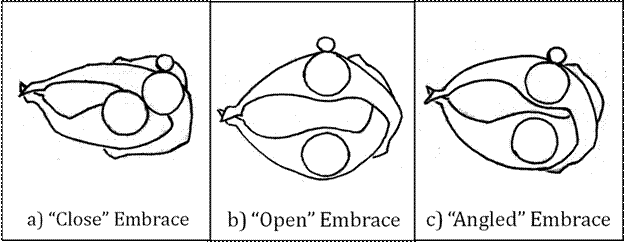
If one is interested in developing the ultimate
partner connection, one can use any of the three styles as a starting point. If
one chooses to dance the “close-embrace” style, the challenge is to first of
all make sure that both partners have their own balance, then to gradually free
up as much of the body as possible, slowly moving towards disconnecting the
heads - in other words to get completely “unstuck“ without losing the
closeness. In order to let this happen, the woman will eventually have to stop
wrapping her arm around the man’s neck, and adopt a less limiting position
around his upper arm and back (it is also the more traditional arm position).
Above all, she will have to stop any leaning or pushing against the man. The
man can also eventually relax the embrace away from the frequent “squeeze” of
the woman’s upper body.
If one initially prefers the “open embrace”, one can gradually
get closer and closer with the partner, without giving up the freedom of body
movement. This is probably the better approach for beginners and also for
people who have become so used to leaning, hanging or pressing, that they are
not even aware of it any longer. The woman can eventually adopt the traditional
arm position, instead of holding the man’s upper arm with her hand. The man can
eventually embrace the woman, instead of placing his hand on her side, as is
usually done in open embrace.
The “angled” position is my preferred compromise. In
this position, the right side of the man is close with the left side of the
woman, while the other side of the couple is more open. In this way the bodies
still feel joined, while the heads and the legs can have some additional room
even with imperfect posture and movement. The woman places her upper arm around
(not on)
the man’s shoulder, without leaning or pressing on it, while the man embraces
her upper body comfortably, without squeezing or creating any rigid “frame”.
The arms’ contact should not be fixed. The only possibly fixed part is the
hands, and even those can shift somewhat.
The main disadvantage of the "angled"
embrace is that the woman's body and feet are not parallel with the man's. This means that at least one of the partners
is going to be stepping somewhat diagonally with respect to his or her body (it
usually ends up being the woman), and also that some closeness and centeredness
will still be lacking. To look for the ideal connection starting from the
angled position means to gradually reduce the angle, becoming more and more
parallel with the partner (see Figure 2c).
It is best not to demand a particular dance embrace of
one's partner. In fact, it is good not to confine oneself to just one of the
three approaches, for each one tends to produce certain bad habits which with
time can become very ingrained. Though I prefer the “angled” embrace as a
starting point, if she insists on head contact in a close embrace, I go along
with it, and try to eventually disconnect from her head through better posture.
If a man's posture is good, the woman will have to actually reach forward with
her head in order to touch his (unless she is terribly slouched herself, which
is not so common in female dancers). Most women have more sense than to do
that. However, it takes time to develop good posture, and in the meantime, I am
definitely going to prefer partners who do not put me into a head lock. If I am
dancing with someone used to the "open" style, I am going to go along
with it initially, but then gradually get closer and closer, trying not to
limit my partner's freedom of movement.
In general, not demanding or expecting anything in
particular of one’s partner is a very important practical consideration. A good
dancer is able to dance easily even with beginners (and yes, this goes for
women as well). A tango master is able to dance with people who have never
danced tango before. This is why, if one wishes to improve, it is best for each
partner to focus on what he or she can do to make the connection and the whole
experience better, while taking one’s partner “as is”. I cannot stress enough how much one’s choice of attitude towards
one’s partner can make or break the quality of connection as well as one‘s whole
tango experience.
The main way to develop the ultimate partner
connection while dancing is
for both partners to intend
it each on his or her own end and look for opportunities to progress towards it
in unforced and creative ways.
Here is a recap of useful intentions:
-
(for men and women) to dance
as closely connected to each other as possible while keeping the freedom of
individual body movement as much as possible;
-
(for men and women)to keep
oneself and one’s partner in perfect balance, without any leaning, pressing, or
hanging;
-
(for women) to move
independently while maintaining an effortless connection, to follow actively,
without being physically propelled by the man;
-
(for women) to effortlessly
stick to one’s partner’s upper body, while at the same time effortlessly
yielding to it;
-
(for men) to eliminate all
manipulation or force in the upper body; to lead nothing with the upper body,
but only “from the waist down” – with the center and the legs;
-
(for men and women) to feel the partner’s transfer of weight and
accompany it;
-
(for men and women) to avoid head contact if at all possible;
-
(for men and women) to
neutralize all effort in one’s body and in partner connection;
-
(for men) to “let” the woman’s step through sinking;
-
(for men and women) to intend a pause within every step, with
both feet on the floor, even as the weight is almost entirely on one foot; to
step while remaining as still and grounded
as possible;
-
(for both men and women, but particularly for women) to separate the
step and the weight transfer by staying rooted in the previous foot as long as
possible, even while moving the body with the partner;
-
(for men and women)to have no sustained
(stuck) contact anywhere on the body except for the hands;
-
(for men and women) to
connect to the center axis of the partner even if one is on the side;
-
(for men and women) to stay
as vertical as possible;
No matter which embrace one prefers, one can always
work on balance, effortlessness, and synchronicity of the connection, by minimizing
pressure through all points of contact, as well as by trying to find stillness
in movement and to accompany the partner in the middle of each step. However,
the best possible partner connection depends on proper body conditions, which
usually require some work off the dance floor. To a human body which can stand
and walk well, good partner connection comes naturally.